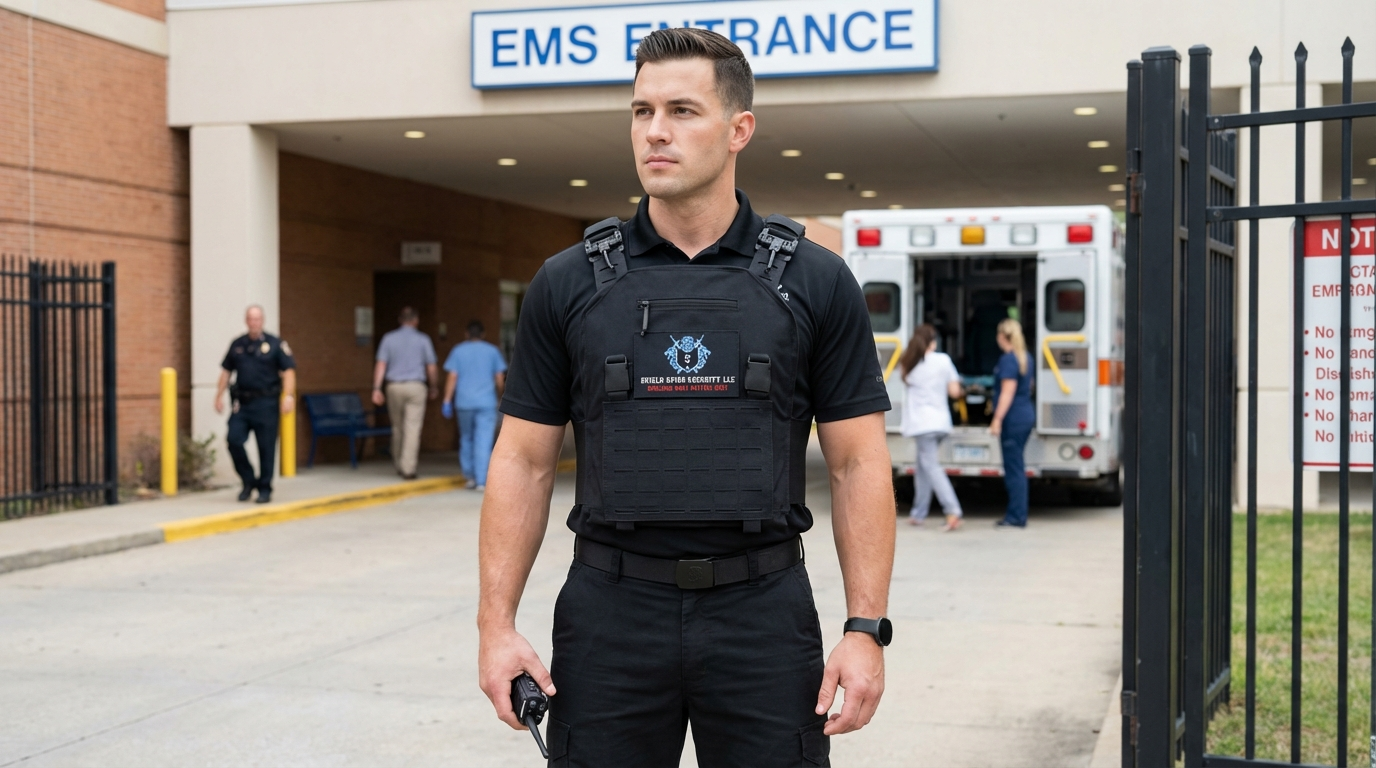
A calm, professional presence in a place people arrive worried
Medical facilities are open by obligation. People arrive unwell, anxious or in a hurry, often outside normal hours, and the security presence has to lower the temperature rather than raise it. Shield Spire scopes healthcare coverage around access, visitors and the parts of the property that sit outside the clinical space.
The parts of a medical facility security actually covers
Clinical care is not a security function, and Shield Spire does not present it as one. What officers cover is everything around it — the entrance, the waiting area, the visitor route, the car park and the hours when most of the building is closed but the doors are not.
- Entrances that stay open outside normal business hours
- Reception and waiting areas where people arrive under stress
- Visitor routes into areas meant for patients and staff
- Parking structures and approaches used late at night
- Deliveries and contractor access to non-clinical areas
- Staff arriving and leaving at shift change
Operational considerations
These are the conditions that most often shape a healthcare security scope — and the coverage that answers each one.
- The entrance is open when most of the building is not
- How coverage answers itAn officer positioned at the open entrance during the hours it is unattended by staff
- Visitors move past reception into patient areas
- How coverage answers itVisitor observation and access support at the point of entry, following your facility's rules
- Tension rises in a waiting area
- How coverage answers itCalm de-escalation as the first response, with escalation to your staff and to emergency services
- Staff walk to their cars after dark
- How coverage answers itOfficer presence or scheduled patrol across parking areas at shift change
- Non-clinical areas need controlled contractor access
- How coverage answers itAccess observation at delivery and service entrances during scheduled windows
- Nobody can confirm what happened overnight
- How coverage answers itGPS-verified attendance and documented shift reporting for every deployment
How coverage would be structured here
Shield Spire has not yet completed a healthcare deployment, so the following describes how a scope would be built — not a claim about past medical-sector work. The components are the same officer capabilities the company delivers today in other environments.
- A staffed presence at the entrance that remains open outside business hours
- Visitor observation and access support consistent with your facility's policy
- A bearing chosen for the setting — calm, professional and non-escalating
- Scheduled patrol of parking areas, approaches and the exterior
- De-escalation first, with a defined escalation path to staff and emergency services
- Documented shift reporting delivered to your facility manager
How a deployment is stood up
Shield Spire does not simply send an officer. Coverage is scoped, assigned, supervised and documented.
- Step 1
Walkthrough
A supervisor walks the property with you to confirm entrances, waiting areas, parking approaches and after-hours access.
- Step 2
Scope
Post position, hours and officer classification are set against the hours the building is exposed and your facility's policies.
- Step 3
Assignment
Texas DPS licensed officers are assigned and briefed on your access and escalation procedures before the first shift.
- Step 4
Coverage
Officers hold the post, support visitor access and patrol the exterior and parking areas through the scheduled window.
- Step 5
Documentation
Attendance is GPS-verified and activity is captured in a report delivered for every shift.
- Step 6
Escalation
Anything requiring a decision reaches a supervisor and your named contact while the shift is still running.
Services that fit this environment
Healthcare scopes usually combine a presence at the entrance with patrol coverage of the property outside the clinical space.
Unarmed Security
The standard classification for a medical setting — calm, professional and appropriate around patients and visitors.
Mobile Patrol
Scheduled patrol of parking structures, approaches and the exterior, including shift-change windows after dark.
Armed Security
Considered only where the property's location or hours warrant it, decided during the walkthrough and never applied by default in a care setting.
What your facility manager receives
The difference between a guard and a security operation is what exists after the shift. Shield Spire deployments are supported by Shield Spire Ops, the operations platform Shield Spire Security uses for scheduling and accountability: officer attendance is GPS-verified, activity is captured in daily activity reports, incidents are documented in a structured format, and supervisors have visibility while the shift is still running.
Where our healthcare experience stands
Shield Spire has not completed a published healthcare deployment. We would rather state that plainly than present unrelated work as medical-sector evidence.
Shield Spire has not published a completed deployment in this environment. Rather than present unrelated work as evidence, this page describes how coverage would be structured — and a supervisor will walk your property before anything is scoped.
Common questions
- Has Shield Spire worked in healthcare before?
- Not in a published deployment. The officer capabilities this page describes — entrance coverage, visitor access support, de-escalation and parking patrol — are ones the company delivers today in other environments, and we would rather say that than imply medical-sector experience we do not have.
- Do you claim any medical-privacy compliance certification?
- No. Shield Spire makes no medical-privacy compliance claim of any kind. Officers provide physical security presence and are not given access to patient records or clinical information, and any handling of protected information remains governed by your own compliance programme.
- Do officers handle patients or provide crisis response?
- No. Officers do not perform clinical roles, do not restrain patients and do not provide behavioral-health or medical crisis response. Their role is presence, access support, observation, de-escalation and escalation to your clinical staff and to emergency services.
- Can coverage be limited to after-hours only?
- Yes, and for many facilities that is the right scope. Coverage is commonly placed on the hours when the entrance remains open but most of the building is closed.
- What about staff safety in the car park?
- Parking areas and approaches are a common part of a healthcare scope, particularly around shift change after dark. That can be a posted officer or a scheduled patrol, depending on the property.
Related environments
Properties with a similar access and after-hours profile.
Plan coverage for your facility
Tell us the property, the hours that concern you and how your entrances are used. A supervisor will walk it with you before anything is scoped.