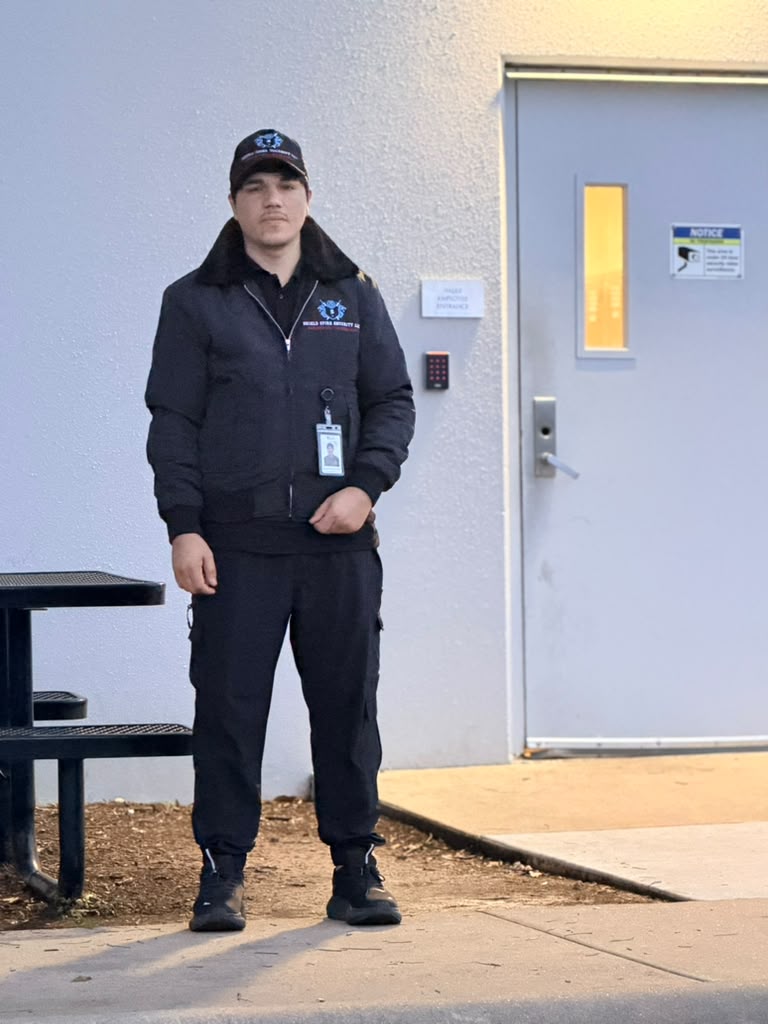
Security that matches how a professional workplace feels
A corporate office has a different problem from a warehouse or a jobsite: the security has to work without making the building feel guarded. Employees, visitors, contractors and deliveries all arrive through the same few doors, and the officer at those doors is often the first person anyone meets. Shield Spire staffs that role deliberately.
The corporate environment, honestly described
Most office risk is not intrusion. It is uncontrolled access — people entering because nobody was positioned to notice, credentials never checked, a visitor unescorted past reception, a door propped during a delivery. The work is attentive, procedural and largely invisible when it is done well.
- Multiple entrances that each need someone accountable for them
- Employee credential checks during peak arrival windows
- Visitors, interviewees and contractors arriving unannounced
- Deliveries and couriers reaching interior floors
- Parking structures and approaches outside the lobby
- Extended business hours and after-hours building activity
Operational considerations
These are the conditions that most often shape a corporate security scope — and the coverage that answers each one.
- More entrances than reception can watch
- How coverage answers itOfficers assigned per entrance so each access point has someone accountable for it
- Credentials are issued but never actually checked
- How coverage answers itOfficers verify employee credentials at entry according to the rules your organization sets
- Visitors reach interior floors without being logged
- How coverage answers itVisitor observation and sign-in support at the point of entry, documented for every shift
- The building stays active past normal business hours
- How coverage answers itCoverage scheduled against actual occupancy rather than a standard nine-to-five block
- A sensitive period — a restructure, a dispute, a departure
- How coverage answers itTemporary uniformed coverage scoped for a defined window, with supervisor oversight
- Leadership needs assurance that coverage was actually delivered
- How coverage answers itGeofenced clock-in with photo verification and daily activity reports submitted every shift
What good corporate coverage looks like
Corporate scopes are built around presentation as much as protection. The officer is a security control and a front-of-house presence at the same time, and the scope should be explicit about both.
- A staffed presence at the primary entrance during defined hours
- Access support at secondary entrances during peak arrival windows
- Credential verification performed to your policy, not to ours
- Visitor observation and escort support where the environment calls for it
- Calm, professional de-escalation consistent with a workplace setting
- Interior and perimeter rounds during quiet or after-hours periods
How a deployment is stood up
Shield Spire does not simply send an officer. Coverage is scoped, assigned, supervised and documented.
- Step 1
Walkthrough
A supervisor walks the facility with you to confirm entrances, reception flow, parking approaches and after-hours access.
- Step 2
Scope
Post positions, hours and officer classification are set against occupancy, entrance count and the sensitivity of the period.
- Step 3
Assignment
Texas DPS licensed officers are assigned and briefed on your access rules before the first shift starts.
- Step 4
Coverage
Officers hold their posts, support credential and visitor checks, and conduct rounds during quiet periods.
- Step 5
Documentation
Daily activity reports are submitted through Shield Spire Ops for every shift, with geofenced attendance verification.
- Step 6
Escalation
Anything requiring a decision reaches a supervisor, and your point of contact, while the shift is still running.
Services that fit this environment
Corporate scopes usually combine a workplace-appropriate officer presence with additional coverage for parking, after-hours periods or specific individuals.
Corporate Security
The office-specific scope: entrance posts, credential support, visitor observation and reception-adjacent presence.
Unarmed Security
The standard classification for a workplace — professional, visible and appropriate to a business environment.
Executive Protection (PPO)
For a specific individual or a defined period of elevated concern, scoped separately from building coverage.
Mobile Patrol
Scheduled patrol of parking structures, approaches and the building exterior outside staffed hours.
What leadership can actually verify
The difference between a guard and a security operation is what exists after the shift. Shield Spire deployments are supported by Shield Spire Ops, the operations platform Shield Spire Security uses for scheduling and accountability: officer attendance is verified through geofenced clock-in and photo confirmation, activity is captured in daily activity reports, incidents are documented in a structured format, and supervisors have visibility while the shift is still running.
Real deployments
Two completed corporate engagements are documented below. Every figure comes from the deployment record.
Corporate Office Access Control & Security Coverage Deployment – Round Rock, Texas
Temporary multi-day coverage for a corporate office facility in Round Rock. Officers supported access control at multiple entrances, verified employee credentials and observed visitor movement during extended business hours, with a daily activity report submitted for every shift.
Read the case study
Overnight Corporate Security Deployment – San Antonio Commercial Construction Facility
Overnight coverage of a commercial construction company's office facility and perimeter in San Antonio, scoped and staffed the same day the request was received — an example of how quickly a short-notice office post can be stood up.
Read the case studyCommon questions
- Will an officer feel out of place in a professional office?
- That is precisely what the scope is written to avoid. Corporate posts are staffed for presentation as well as protection — officers are briefed to be professional and approachable, because at the entrance they are often the first person a visitor meets.
- Do officers operate our badge or access-control system?
- Officers support access control according to the rules you set — verifying credentials, observing entry and documenting what happens. Shield Spire does not install, own or administer badge systems, and officers do not set access policy.
- Can we book coverage for a short, specific period?
- Yes. Temporary engagements are common — a sensitive transition, a defined project window, or a period of elevated concern. Shield Spire has completed multi-day temporary corporate coverage scoped exactly that way.
- Can one officer cover several entrances?
- Only by leaving some unattended. Where several entrances need to be accountable at once, the scope assigns an officer to each; where it does not, coverage concentrates on the primary entrance with rounds covering the rest.
- How do we confirm officers were actually on post?
- Attendance is verified through geofenced clock-in and photo confirmation, and a daily activity report is submitted for every shift.
Related environments
Properties with a similar access and after-hours profile.
Plan security for your workplace
Tell us the building, how many entrances need cover and the hours involved. A supervisor will walk it with you before anything is scoped.